|
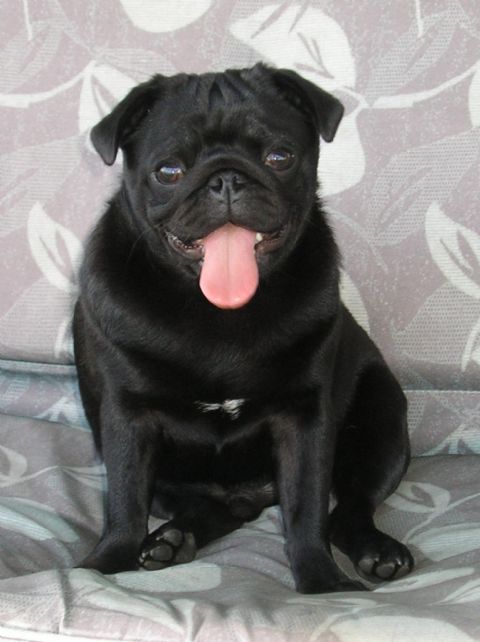
Pug colours are one of the most highly debated topics on the Internet. Many people won't find the information on this page
important, but if you are just plain curious or have a scientific mind, it's all here for you to ponder.
If you don't have any idea what basic colours Pugs come in , you should check out the Pug Colour section on the
Breed Standard Page first.
Genetics Basics
We will start with some basics and continue to build from there.
Lets look at Genes.
We all have them. Genes are part of Chromosomes, and Chromosomes are the very building blocks of what makes up what we are. Like beads on a string, where the bead is the Gene and the string is the Chromosome.

The Genes are what you inherit from your parents and they actually lay on the string in pairs: you get one Gene from your mother, and one from your father. Genes reproduce themselves accurately from one generation to the next, so you get the same thing each time. The exception to this rule is where a Gene does not reporduce itself at some point.
This is known as a mutation.
The two Genes that go to make up a pair will stick together at the same point on the Chromosome. This is how we've learned which Genes are responsible for colour, the type of coat, etc. That single point for the Gene is known as the Allele and any Allele will hold variations of the same Genes.
If the Genes aren't the same type, one has to be the dominant or more important than the others at the same Allele. For example, if you have a Gene for red, blue and green skin, there has to be some ranking of one above the others. If red is the dominant Gene, then even if the other Gene at that Allele is a blue or green, the skin will still be red.
This leads us to Phenotype and Genotype.
The Phenotype of a dog are the traits you can actually see, for example, you can see the dog has red skin. The dog is Phenotypical for red skin. The Genotype is the actual traits the Genes of the dog carries. So if the example above has one Gene for red skin and one Gene for for blue skin, it actually carries the Genes for both red and blue, even though you only see the red ones. When defining what Allele a dog has, is is generally shown as a 'shorthand' symbol, for example, if red is dominant, it would be shown as a capitol letter 'R'. A dog that carries both Alleles for red skin would be shown as "RR" for two dominant red Genes. If the dog in our example was to have one red Gene and one Gene for blue, it would be written as "Rb". The smaller letter 'b' signifies that the blue Gene is recessive(non-dominant).
Are you with us so far??
Now, the basics for the Pug colours of fawn and black are just as easy as that too. You have a 'BB' for a pure, dominant black dog, and a 'ff' for a pure fawn. Now, the first thing you should have noticed is that the B's are in upper case and the f's are in lower case. That means that the fawn is a recessive colour to the black. Now, notice that we said "pure black" and "pure fawn" - if you mix fawns and blacks, you get the Alleles mixed up for fawn and black. The diagram below shows the possible combinations you can get when you breed a pure black to a pure fawn. The top row is blue as they are the Genes from the Sire/Father and the left side is pink as they are for the Dam/Mother.


Ahh, yes but, we hear you ask.
We have a new group of dogs, genetically - the Hybrid Blacks.
These are actually dogs that, because they have the dominant Black Gene will have black coloured coats, BUT also carry the fawn Gene. This puts a whole heap of extra information into the mix when it comes to working out what colours you may get in a litter. So let's add this information to the above table, and see what happens.


Confused yet ??
Pug colours can be very daunting. Especially if you don't know if your little darling Pug is a pure black, pure fawn or a hybrid black. One thing for certain though, if you have a fawn Pug, it is a pure fawn as the fawn Gene is recessive to the black. It only takes just one black Gene and your Pug would look black instead of fawn.
If you are wondering about the colour apricot, it is the same as for a fawn. It is also a recessive Gene to the black.
Well, that pretty much covers the basics of colours in Pugs. Wait a minute though, there are colours missing you say. What about brindles, spotted or striped Pugs. Those colours aren't shown because there are NO Genes for those such colours in Pugs. The only accepted colours for Pugs are fawn, apricot, black and the very rare silver, regardless of what you see in pictures or what grandma tells you she had when she was young.
Genes For Colour - An Indepth look
In this section we will look at where the different colours come from. But be warned, the topic does get more technical from here on.
Each Allele is inherited from one of the parents, so there is a 50/50 chance that whatever the parents are, the pups will also be. The catch is when what you see (the Phenotype) is different that what the parents actually carry (the Genotype). Only by test breeding can you possible determine or even get a hint of the actual Genotype of the dog as there are so many possibilities for colours.
All dogs seem to have the same basic inheritance of colours - the Genes all follow the same patterns of dominance in all breeds. This makes talking about the colours of dogs very easy as it is all done the same way. The Genes that affect coat colour are described with letters that represent the Gene or the Allele that produces a specific colour. There are 9 basic Locuses (Gene intersections) that have been determined to affect colour in dogs, but we don't have to worry about all of them. The basic Genes at the 9 Locuses in dogs are:
A or Agouti Locus: The most complex Gene with at least five different Alleles
-- A is the Gene for a dominant black coat
-- ay is the dominant yellow colour
-- ag is the agouti or wolf colour
-- as is a saddle pattern over the body, with a black or liver brown wide saddle that spreads over the shoulders and is accompanied by tan markings on the head and legs.
-- at is a dark saddled dog with tan points. ie: tan eyebrows, cheeks, chest and legs. In this case the saddle almost covers the entire body.
B or Black: This means a dog can have black or dark pigment. Only two Alleles here, and B is dominant to b in all cases.
-- B is for black coat.
-- b is for chocolate, liver or tan colours when there is a dark coat colour.
C or Albino: This Gene allows colour to be formed or not according to specific patterns.
-- The dominant Gene is C, which allows colour to be formed in the coat.
-- ch produces a chinchilla look to the coat.
-- cd is a white coated dog with black nose and dark eyes.
-- cb is the white or very pale grey coat on a dog with blue eyes.
-- c is an albino coat with pink nose and pink eyes. The pink colour indicates that melanin can't form in the hairs to show the colours.
D or Dilution: Has again only two Alleles.
-- dominant D for intense pigment.
-- recessive d which causes the pigment to dilute the colour. How much dilution occurs depends on what colour the dilute is modifying.
E or Extension: This Gene causes extension or restriction of dark or black pigment in the coat, including the black mask, the brindle coat colour and more. We will look at how this particular Locus works later on.
-- dominant is Em, which causes black pigment to be formed in the coat with a black mask.
-- next is E which allows black pigment in the coat without a black mask.
-- next comes ebr which is the brindle Allele, permitting black pigment to form stripes throughout the coat.
-- then e does not allow black pigment to be formed even if the dog carries the black pigment Gene.
G or Greying: This is not old age grey around the muzzle or premature aging in a dog, but the gradual natural lightening of the coat as a dog matures.
-- G gives a coat colour overall that lightens with age.
-- g does not lighten with age.
S or Spotting: Spotting defines the white markings on a dog, whether they are widespread or just a few spots.
-- S for self-coloured or totally solid pigmented coat.
-- st for Irish spotting, which shows a few definite areas of white (toes, chest, belly, muzzle or tail)
-- sp produces pinto or piebald spotting
-- sw is extreme white piebald colouring.
T or Ticking: This Gene puts tiny flecks of dark hairs into the white coat. The most obvious 'ticking' is that of the dalmation breed.
-- dominant T causes small coloured spots into white areas of a coat.
-- recessive t has clear white spots on a coat.
One thing that is nice, is that most of these don't apply to Pugs. Well not pure bred Pugs anyway. It has been proven over time, with specific breeding tests, that pure bred Pugs are Homozygous (both Genes inherited from the parents are the same) and ALL Pugs carry the following set of Genes.
BDEmgSt
Black Pugs carry either AA for pure black (AA BB CC DD EmEm gg SS tt) or Aay for the hybrid blacks
(Aay BB CC DD EmEm gg SS tt), and have at least one C Gene.
It is suspected that the apricot fawns carry ayay with the C Gene. The true silver colour is ayay with probably the cch Allele instead of the C (ayay BB cchcch DD EmEm gg SS tt) so it is easy to see how difficult it would be to have a true silver, as the cch Gene is very difficult to find in Pugs at all, let alone to find two and mate them. White spots on Pugs (fawns also have white spots) are the result of the dog carrying one of the s modifying Genes, rather than the S Gene.
Now let's look at the other most commonly mistaken Pug colour, the brindle colour, and see how it cannot occur in a pure bred Pug. First, the working of the ayay Gene produces the red, tan or fawn coat (as in this case). The Em is dominant to the plain E and plain e as well. That means that dogs which carry EmEm, EmE, and Eme, will all appear to be the same: fawn with a black mask. Only by having breeding records of the parents and their offspring could you determine which specific Gene a specific dog carries.
The Allele A for black coat, coupled with the brindle Gene ebr will produce black solid dogs, since A conceals the brindle Gene. The brindle Gene, ebr when found in conjunction with an Em will ALWAYS show up as a dog with brindle markings and a black mask. The combinations of Eebr or ebrebr will produce the brindle without a black mask, or brindle all over. But ANYTIME the ebr Gene is present - even if there is just one solitary Gene - the dog will have a visible brindle coat colour. That means you cannot have a recessive brindle, you cannot have a 'hidden' brindle Gene - unless it is in a solid black dog that masks the Gene. But any dog with a brindle Gene that is not black will show the brindle colouration.
So when someone tells you that they bred a fawn sire to a fawn dam and got a brindle puppy..... it physically cannot happen genetically. Some other dog which DOES carry the brindle Gene MUST have been the sire if the dam is a fawn Pug.
Pugs have carried the Em Gene for well over 100 years (that is, every dog has EmEm) and this was demonstrated during test breedings back in the 1940s under controlled scientific condition.
So dogs with the brindle Gene today must have been introduced from another breed carrying the ebr Gene,
making it a cross-bred dog.
THAT'S IT !!
If you have gotten this far and read the entire thing, either you understand how your darling little Pug gets it's colours and appearance, or you are completely mind blown and totally lost.
Either way, we hope you have enjoyed reading about the genetics of Pugs.
|